
Research
Why Do Hardworking Students Still Fail?
Research Question
Why do students who study extremely hard still fail competitive examinations?
Background
Between 2018 and 2023, I prepared for the National Eligibility cum Entrance Test (NEET), one of India’s most competitive entrance examinations.
Across multiple attempts, I experienced almost every stage of the preparation journey.
Some years I lacked discipline.
Some years I was inconsistent.
Those failures were understandable.
But one particular year was different.
For the first time, I genuinely believed I had done everything within my control.
I was studying 12–14 hours a day.
I had stopped attending social events.
I consistently gave mock tests.
My scores were improving.
My preparation felt strong.
Everything suggested I was ready.
On the day of the examination, I unexpectedly developed a high fever inside the examination hall.
Despite completing the exam, the result was significantly below what my preparation indicated.
The following year presented a different challenge.
Approximately ten days before the examination, I experienced a severe panic attack, required hospitalization, and was diagnosed with anxiety.
Again, my preparation and my performance diverged.
By my final attempt, I achieved my highest score.
Yet even then, it wasn’t enough to secure admission into a government medical college.
The outcome itself was disappointing.
The contradiction was far more interesting.
flowchart TD
  A[2018-2023<br/>Prepared for NEET across multiple attempts] --> B[Some years<br/>lacked discipline]
  B --> C[Some years<br/>was inconsistent]
  C --> D[One particular year<br/>studied 12-14 hours a day]
  D --> E[Examination day<br/>developed a high fever inside the examination hall]
  E --> F[Following year<br/>panic attack, hospitalization, anxiety diagnosis]
  F --> G[Final attempt<br/>achieved highest score, still not enough for government medical college]
The Contradiction
At first, I assumed the explanation was simple.
Maybe I hadn’t worked hard enough.
Maybe my concepts were weak.
Maybe I had simply been unlucky.
But none of those explanations fully satisfied me.
There seemed to be a consistent pattern.
The amount of effort I invested did not always predict the outcome I achieved.
That raised a much larger question.
If hard work alone cannot explain performance, what can?
Initial Hypothesis
Initially, I believed success in competitive examinations could largely be explained by academic variables.
I assumed factors such as:
- study hours
- number of questions solved
- mock test performance
- revision consistency
would almost entirely determine the final outcome.
Mental health appeared secondary.
Physiology wasn’t something I considered at all.
Investigation
Rather than immediately searching academic literature, I started by looking for other students who had experienced something similar.
I began reading discussions across platforms such as Reddit, Quora, and student communities.
Initially, I expected to find isolated incidents.
Instead, I found thousands.

Students repeatedly described experiences such as:
- panic attacks before examinations
- blanking out during tests
- inability to sleep
- stomach discomfort
- loss of appetite
- racing thoughts
- anxiety
- burnout
- emotional exhaustion
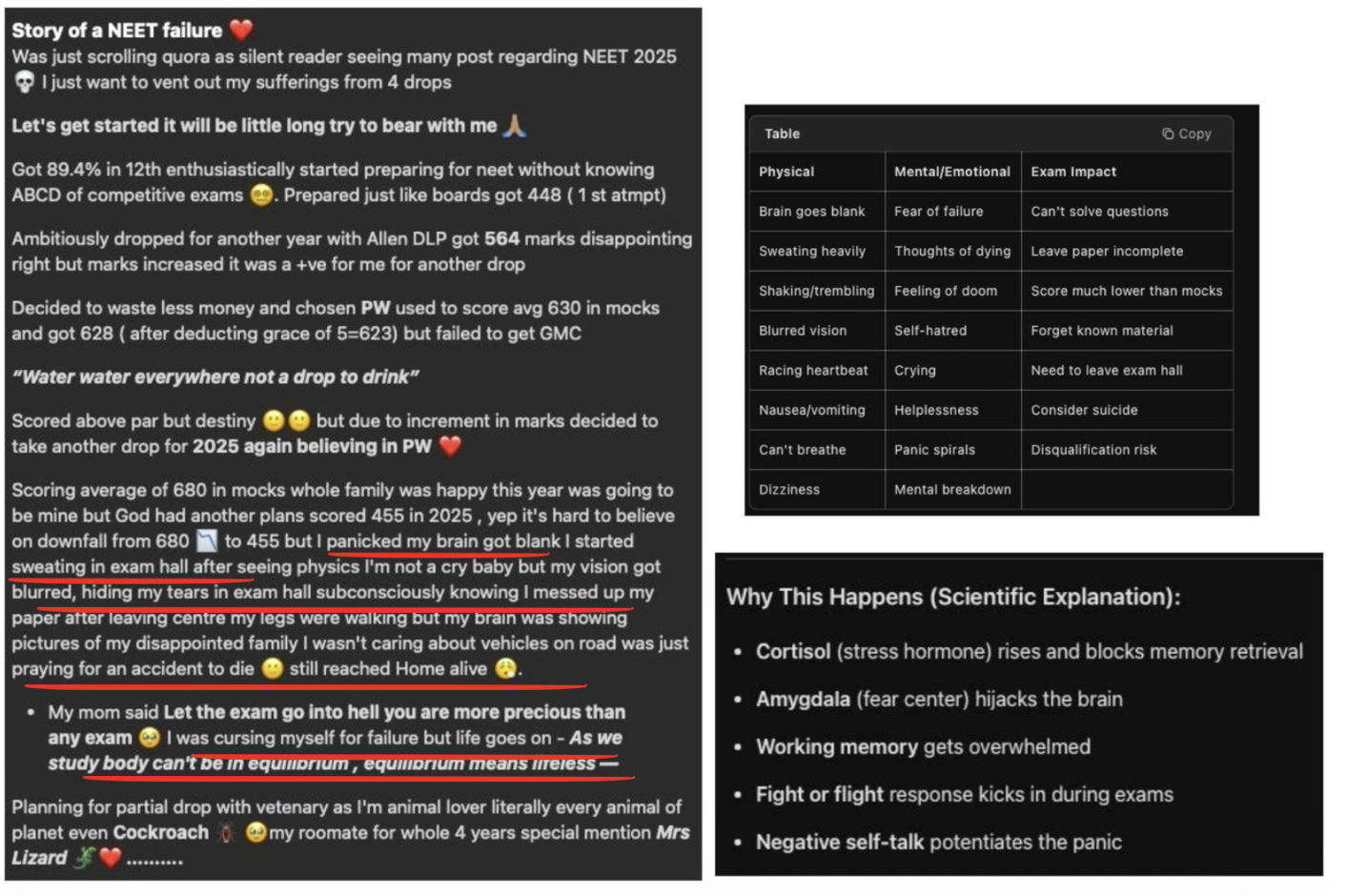
The pattern appeared too frequently to dismiss as coincidence.
The question was no longer:
Why did this happen to me?
It became:
Why does this happen to so many students?
flowchart TD
  A[Personal experience] --> B[Look for similar student experiences]
  B --> C[Reddit]
  B --> D[Quora]
  B --> E[Student communities]
  C --> F[Thousands of repeated patterns]
  D --> F
  E --> F
  F --> G[The question changed]
  G --> H[Why does this happen to so many students?]
A Second Question Emerged
As I continued researching, another observation became increasingly difficult to ignore.
Most educational products focused almost exclusively on academics.
They optimized:
- lectures
- practice questions
- revision
- test analysis
Students were often treated as if improving academic input alone would automatically improve academic output.
Yet many students already knew what they needed to study.
Their difficulty wasn’t knowledge.
It was sustaining performance under prolonged stress.
This suggested that an important part of preparation was being ignored entirely.
A New Direction
This shifted my attention away from education and toward human performance.
I wanted to understand:
- What happens inside the body during prolonged stress?
- Why does sleep deteriorate?
- Why does breathing change?
- Why do some students blank out despite knowing the material?
- Are there measurable physiological changes before performance declines?
These questions marked the beginning of a much broader research journey.
What Changed
Before beginning this investigation, I believed competitive examinations were primarily academic problems.
After months of observation, I no longer believed that.
I started viewing exam preparation as the interaction of three different systems:
- Knowledge
- Psychology
- Physiology
Ignoring any one of them creates an incomplete understanding of performance.
flowchart LR
  A[Knowledge] <--> B[Psychology]
  B <--> C[Physiology]
  C <--> A
  A --> D[Performance under pressure]
  B --> D
  C --> D
Implications
This investigation fundamentally changed the direction of my work.
Rather than asking:
“How can students study more?”
I started asking:
“How can students perform consistently under pressure?”
That shift eventually led to four independent research directions.