
Research
Can Physiology Improve Academic Performance?
Research Question
Can physiological signals be used to improve academic performance while simultaneously identifying early signs of deteriorating mental well-being, allowing interventions before students reach burnout?
Why This Question Emerged
The previous stages of this research established two independent observations.
First, thousands of students preparing for competitive examinations were experiencing anxiety, panic attacks, sleep disruption, burnout and declining motivation despite studying consistently.
Second, the scientific literature repeatedly showed that physiological systems—particularly autonomic nervous system regulation and sleep—play a central role in learning, memory formation, emotional regulation and cognitive performance.
These two observations naturally led to a new question.
If physiology affects learning, could it also become something that educational systems actively measure?
Instead of asking students to simply study harder, could a system understand whether their body was actually ready to learn?
This became the central question of this investigation.
flowchart TD
  A[Student experiences<br/>anxiety, panic attacks, sleep disruption, burnout] --> C[New question]
  B[Scientific literature<br/>physiology affects learning, memory, regulation, performance] --> C
  C --> D[Could educational systems measure physiological readiness?]
Initial Hypothesis
The initial hypothesis was intentionally simple.
If physiological readiness changes throughout the preparation journey, then those changes should influence both academic performance and psychological wellbeing.
Rather than treating academic performance and mental health as separate domains, they could potentially be viewed as different outcomes of the same underlying physiological state.
From this hypothesis emerged a second question.
Can a single readiness metric capture enough information to support both?
Literature Foundation
The investigation began by reviewing research across multiple disciplines.
Instead of searching specifically for “student performance,” the literature review expanded into adjacent fields where physiological monitoring had already been extensively studied.
Areas explored included:
- Heart Rate Variability (HRV)
- Sleep architecture
- Memory consolidation
- Executive function
- Stress physiology
- Autonomic nervous system regulation
- Cognitive neuroscience
- Burnout research
- Wearable health monitoring
- Recovery metrics used in elite athletics
Over several months, hundreds of papers were reviewed and consolidated into an internal literature review document.
One observation appeared consistently across almost every field.
Physiological readiness influences cognitive performance.
The relationship appeared repeatedly regardless of population, methodology or study design.
Choosing Physiological Signals
Modern wearables can measure dozens of physiological variables.
Initially, several possibilities were considered.
- Heart Rate Variability
- Sleep
- Skin Temperature
- Galvanic Skin Response
- Resting Heart Rate
- Respiratory Rate
Each metric offered different advantages.
However, building a practical system required balancing three constraints.
The signal needed to be:
- strongly supported by literature,
- measurable using commercially available wearables,
- and suitable for longitudinal monitoring.
After reviewing the evidence, the investigation focused primarily on two variables:
- Heart Rate Variability
- Sleep
These appeared consistently throughout cognitive science literature while also being widely available through wearable devices.
Designing the Focus Score
The objective was never to create another wellness score.
Existing wearable platforms already produced recovery, readiness and stress metrics.
Instead, the objective was different.
Those scores had largely been designed around athletic recovery.
The question here was whether a readiness score could instead be optimized for academic performance.
The proposed framework became known internally as the Focus Score.
Rather than measuring fitness, the score attempted to estimate physiological readiness for learning.
Conceptually, the score combined multiple physiological inputs into a single interpretable readiness value.
The intention was not to diagnose health conditions.
Instead, it served as a decision-support signal for study planning.
flowchart LR
  A[Heart Rate Variability] --> C[Focus Score]
  B[Sleep] --> C
  C --> D[Physiological readiness for learning]
  D --> E[Study planning decision-support]
Validation Strategy
Developing a physiological metric without validation would provide little scientific value.
Rather than relying on anecdotal observations, an external dataset was required.
A publicly available clinical dataset containing wearable physiological measurements alongside validated mental health assessments was selected for evaluation.
The dataset included:
- continuous wearable measurements,
- sleep data,
- Heart Rate Variability,
- standardized depression assessments,
- standardized anxiety assessments,
- standardized insomnia assessments.
The algorithm was applied without modifying the underlying clinical measurements.
The objective was not to prove the algorithm correct, but to evaluate whether meaningful relationships emerged.
flowchart TD
  A[Public clinical dataset] --> B[Wearable measurements]
  A --> C[Sleep data]
  A --> D[Heart Rate Variability]
  A --> E[Depression assessments]
  A --> F[Anxiety assessments]
  A --> G[Insomnia assessments]
  B --> H[Focus Score evaluation]
  C --> H
  D --> H
  E --> I[Relationship analysis]
  F --> I
  G --> I
  H --> I
Key Findings
Several observations consistently appeared during analysis.
1. Physiological readiness correlated with mental health measures.
Students with lower physiological readiness generally demonstrated higher levels of depression, anxiety and insomnia.
The relationship remained statistically significant across multiple analyses.
2. Readiness was not binary.
Students did not simply fall into “healthy” and “unhealthy” groups.
Instead, readiness existed along a continuous spectrum.
Higher readiness generally corresponded with improved psychological outcomes.
Lower readiness consistently aligned with poorer outcomes.
3. Chronic patterns appeared more informative than individual days.
A single low-readiness day was rarely meaningful.
However, sustained periods of reduced readiness often coincided with worsening psychological measures.
This suggested that trends may provide more value than isolated measurements.
4. Different deterioration patterns emerged.
Not every student showed the same physiological trajectory.
Two broad patterns became apparent.
Some students demonstrated sudden physiological decline following acute stress.
Others remained in chronically suppressed physiological states for extended periods.
These patterns appeared fundamentally different and likely require different intervention strategies.
5. Physiology appeared before self-report.
In several cases, measurable physiological deterioration appeared before students completed mental health questionnaires.
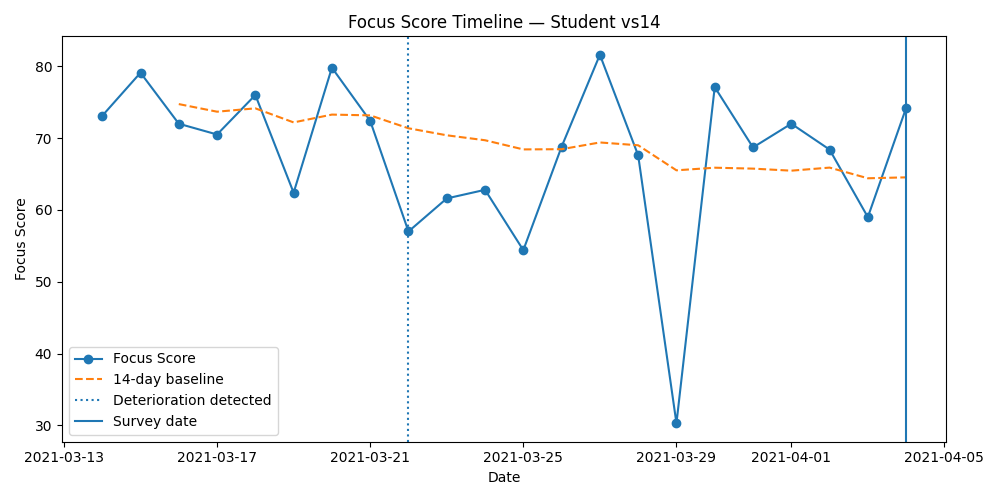
Although preliminary, this observation suggested that wearable data might identify changes before students consciously recognize them.
This remains an area requiring significantly larger validation studies.
Implications
If physiological readiness genuinely influences learning, then current educational systems optimize only half of the equation.
Today’s educational platforms measure:
- study hours,
- completed questions,
- mock test scores,
- revision frequency.
They rarely measure whether the student’s nervous system is capable of effectively learning on that particular day.
This creates an important distinction.
Current systems optimize activity.
A physiological approach attempts to optimize readiness.
What This Research Does Not Claim
This investigation does not claim that physiological data can diagnose mental illness.
It does not replace psychologists, psychiatrists or medical professionals.
It does not suggest that academic performance depends solely on physiology.
Instead, it proposes that physiological readiness represents an important—and currently neglected—component of learning.
The Focus Score should therefore be interpreted as a decision-support framework rather than a medical instrument.
Limitations
Several limitations remain.
The validation dataset was relatively small.
The Focus Score was evaluated retrospectively rather than prospectively.
Different wearable devices introduce measurement variability.
Academic outcomes were inferred through physiological readiness rather than measured directly.
These limitations require future longitudinal validation involving real students preparing for competitive examinations.
Conclusion
This investigation began with a simple question.
Could physiology explain part of the performance differences that traditional educational systems overlook?
The evidence gathered throughout this research suggests that physiological readiness deserves significantly greater attention within education.
Rather than separating academic performance and mental wellbeing into independent systems, they may represent interconnected outcomes influenced by the same underlying physiological processes.
The Focus Score represents one proposed framework for measuring those processes.
Whether it ultimately becomes the best solution remains an open question.
However, the investigation fundamentally changed one assumption.
The question is no longer:
How many hours did the student study?
The more important question may be:
Was the student’s body ready to learn?